Your cart is currently empty!
Tag: California Science Center
-

King Tutankhamun , The Nine Year Old Pharo
‘A nine year old king’ sounds like the stuff of a fairy tale yet it is no fairy tale! King Tutankhamun who ruled Egypt thirty three centuries ago was the son of King Amenhotep IV (better known as Akhenaten) & grand-son of King Amenhotep III. He came to the throne of Egypt at nine years of age! Just as Tut’s father, Akhenaten, had deserted his own father’s religion of many deities & upheld one deity, Aten the sun disk, young King Tut ended his father’s one deity practices, destroying its monuments & artistic manifestations, & returned to the numerous deities of his grandfathers. The young king did not live long though; some think he died at age 15 or 16 while others put it at 19 years of age. Modern DNA research & other state of the art technologies are increasingly revealing more about his life and death. But enough is already known anyway about his short reign, his half-sister-wife Ankhesenamun (Nefertiti’s daughter) & their off-spring (two still-born daughters whose fetuses were found in Tut’s tomb).

Howard Carter’s discovery of Tut’s tomb in the Valley of the Kings, officially known as The Great and Majestic Necropolis of the Millions of Years of the Pharaoh, Life, Strength, Health in the West of Thebes, outside modern Luxor, is itself fantastic in its ups and downs and has captivated the world’s imagination alike with its facts as with its rumors of Pharaoh’s curse and other lore which kept the cinema industry going for decades.

November 4th, 1922 was the day Carter found the staircase which led to King Tut’s tomb. Although the antechamber has clearly been tampered with by robbers, Carter’s description of his first glimpse of its contents is still stunning. At first, he could see nothing in the light of the candle he inserted through a hole drilled in the door, but as his eyes “grew accustomed to the light, details of the room emerged slowly from the mist, strange animals, statues, and gold — everywhere the glint of gold”. The actual burial chamber was opened in February 1923. This is where Carter found a series of gold sarcophagi at the heart of which lay the mummy of young king Tut with his solid gold funerary mask on his face & chest and gold sandals on his feet. There was yet another smaller room which contained the “greatest treasures of the tomb”; both of these chambers have fortunately escaped grave robbers for 3,000 years!

If having one’s name and life-story kept up in people’s minds and hearts renders one immortal, then young King Tut “is pretty spry for a guy who is more than 3,000 years old”, as Jesse Baker said in 2011. One might think that it is an indisputable fact that the young Pharaoh (with his treasure) has travelled more extensively after his death than in his life time! Only till one discovers that King Tut’s real remains have never left Egypt; what goes on display is an exact life-size 3-D replica made possible by CT scans. Nevertheless, it is the most widely archeological/artistic travelling exhibition from ancient Egypt. From the 1960s onwards, King Tut has so far visited the UK, Soviet Union, United States, Canada, Japan, France, Switzerland, and Germany etc. The last time an exhibition of King Tut’s treasures toured the US was not so long ago. Tutankhamun and the Golden Age of the Pharaohs exhibition started in Los Angeles County Museum of Art in June 16 to November 15, 2005. It then toured 18 cities in the US before leaving for Australia in January 2011.

A popular Egyptian saying claims that whoever drinks of the waters of the Nile is bound to return for more! It seems one can assert the same for the waters of North American rivers. King Tut is indeed back in Los Angeles. “King Tut: Treasures of the Golden Pharaoh” is at California’s Science Centre from March, 2018 onwards for ten months with extended summer visiting hours.

This exhibition is the result of the collaboration of Egypt’s Ministry of Antiquities, Exhibitions International, IMG, and the California Science Center. Mostafa Waziry, the ministry’s secretary general, is on record saying, “To celebrate the 100th year anniversary of the discovery of the tomb of the boy king, Tutankhamun, as a part if the celebration, Egypt is sending 150 masterpieces to tour all over the world”. Among those 150 artifacts and antiquities are sixty which are on display for the very first time outside of Egypt. “Some stories are everlasting, and that is the case with the legend of King Tut,” said President of Exhibitions International, John Norman who also produced Tutankhamun’s earlier exhibitions. “For this new exhibition, we have curated an extraordinary collection of treasures from King Tut’s tomb and given this historical discovery a timely new dimension. Visitors will be truly immersed in a modern presentation like no other”.

The pleasure of California Science Center President, Jeff Rudolph, is evident in his assertion, “We are pleased to host the world premiere of ‘King Tut: Treasure of the Golden Pharaoh’ “. He added further, “Its ornate artifacts and multimedia displays will stimulate interest in the many sciences related to archaeology”.
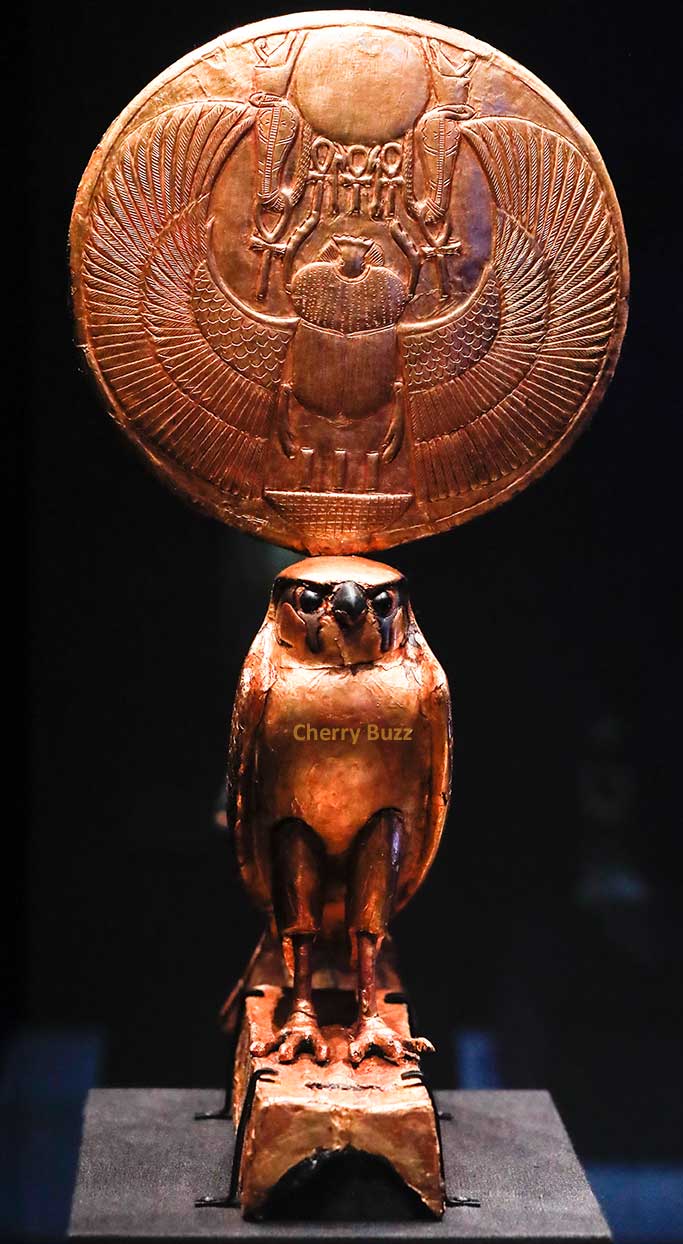
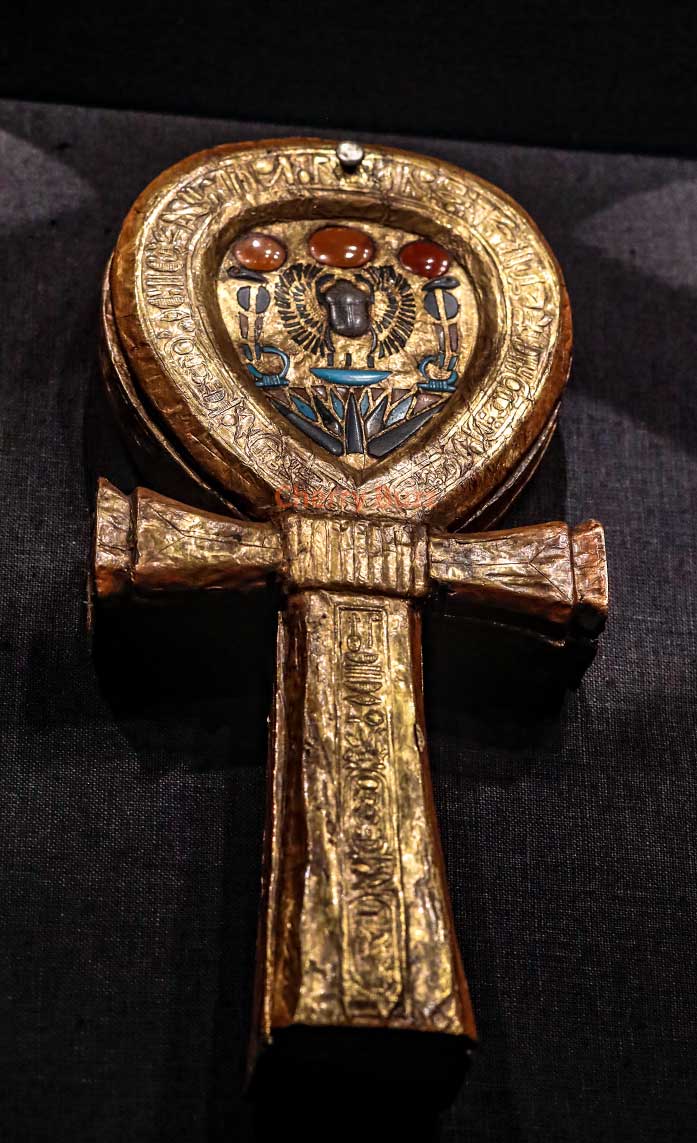
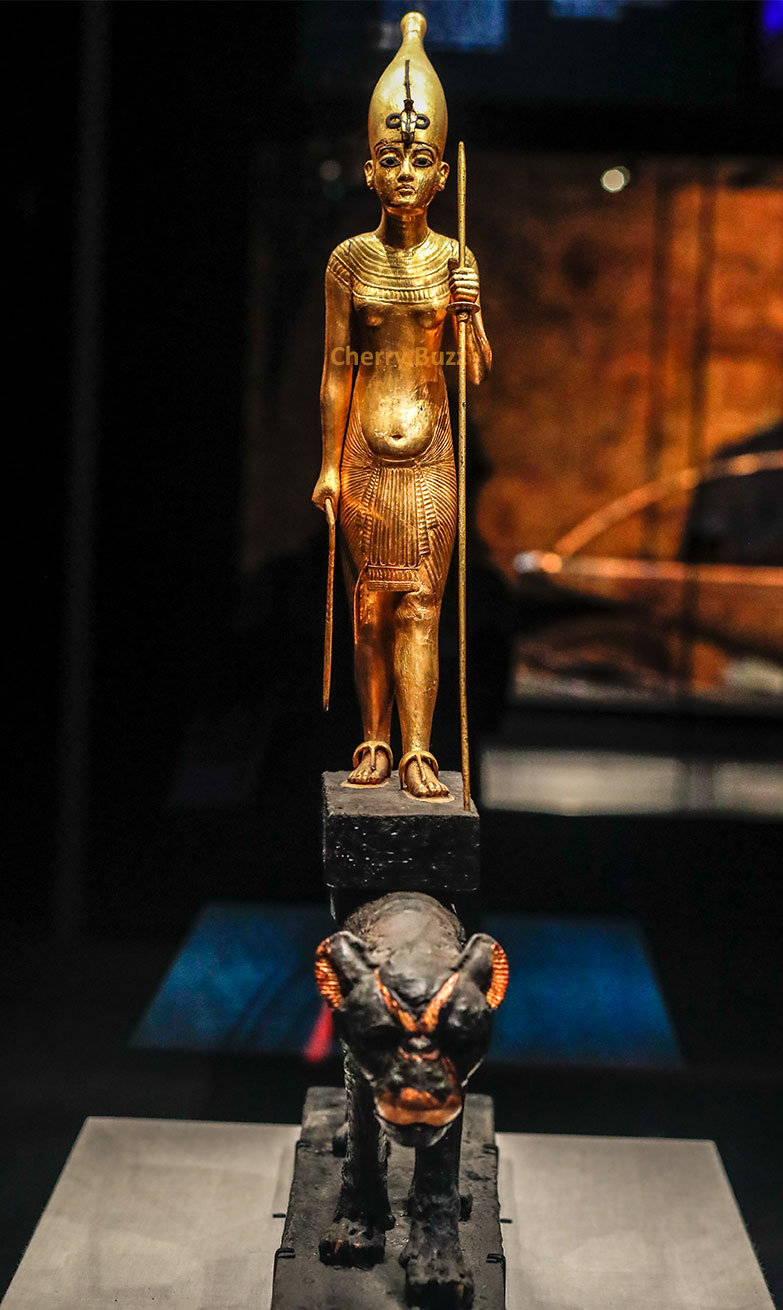
The exhibition is a truly memorable experience which enables the visitor to trace the boy King’s journey from death to the after-life and explains the significance of each artifact interred with him. Thus there is, for example, a statue denoting the pharaoh’s resurrection at dawn, an exquisite wooden shrine with scenes of Tutankhamun and his wife Ankhesenamun giving a rare glimpse of the daily life of a royal household and a jeweled caffinette which held the King’s mummified liver with the goddess Isis depicted on each lid for protection. The exhibition features “nine distinct experiential galleries and an array of 3D visuals, digital content, 360-degree theatrical manifestations, custom soundscapes and more in an engaging, audio-guided tour”.
It is indeed a new experience altogether where dazzling multimedia enhances rare artifacts in ways never achieved before, taking us, the exhibition visitors, on an immersive journey of Tut’s quest for immortality. We were able to see and get in-depth information on the exquisite rings found on Tut’s fingers, the opulent jewelry that adorned his body, and those gold sandals which we have mentioned before. It is definitely a once-in-a-lifetime chance also to discover how the CT & DNA analysis of Tut’s 3,300 year old mummy together with other cutting-edge technologies have revealed new information about the boy king’s health , lineage and possible cause of death.

Zahi Hawass, the well-known archaeologist shares the same vision about the boy King’s exhibition. On August 11th “A night at the museum with Dr. Zahi Hawass” event at the California Science Center, Dr. Hawass is due to present the latest updates on his excavations in the Valley of the Kings. Then he will hold a private exhibition viewing of the KING TUT.

Last but by no means least, the boy king is clearly still looking after his interests and those of his people. If earlier tours of US cities benefited Egypt little financially, as Mark Lach, senior vice president for Arts and Exhibitions International, the organization which negotiated Tut’s return to the US, this is not the case this time around. When the boy king and his treasures go home this time, there will be also about $80 million to take back to Egypt. He is thus raising funds for Egypt, partially to preserve pharaonic temples and monuments but primarily to help the construction of ‘The Grand Egyptian Museum’ which will be his final resting place.

For further information about King Tut, you may consider the following links:
https://www.nationalgeographic.com/archaeology-and-history/magazine/2018/03-04/findingkingtutstomb
https://interactive.wttw.com/remembering-chicago/tutmania-field-museum
https://www.neh.gov/humanities/2015/septemberoctober, vol. 36, Number 5
https:// nationalgeographic.com
https://www.npr.org/2011/01/13/132743793/king-tutankhamens-farewell-tour
https://californiasciencecenter.org/exhibits/king-tut-treasures-of-the-pharaoh
https://www.eventbrite.com/e/a-night-at-the-museum-with-dr-zahi-hawass-tickets-47166098069
https://californiasciencecenter.org/Press-room/Press-releases/king-tut-treasure
https://foxla.com/entertainment/features/king-tut-treasures
https://www.nationalgeographic.com/archaeology-and-history/magazine/2018/03-04/findingkingtutstomb
https://interactive.Wttw.com/remembering-Chicago/tut mania-field-Museum -
BODY WORLDS: Pulse Exhibition at the California Science Center
The History of California Science Center
A visit to the California Science Center, at Exposition Park, Los Angeles, is at once amazing and breathtaking as well as highly enlightening for children and adults alike. That part of Los Angeles has gone through one transformation after another from the days when, from 1872 to 1910, the site held open agricultural fairs till the California State Exhibition building was erected in 1912. In those early days, the building displayed agricultural and industrial products. But it was in 1951 that it became the California Museum of Science and Industry. Then in the late 1980’s an ambitious 25-year plan was devised for a much larger facility to be renamed the California Science Center. The Northridge Earthquake of 1994, which damaged the building, put a keener impetus on the plan and the building was closed in 1996.
The first phase of the plan was completed and the Center was opened in 1998. New wings and extensions have been accomplished and now the California Science Center not only has galleries with exhibits on continuing loan from NASA and the Smithsonian Institution, it also boasts a seven-storey IMAX screen and the Wallis Annenberg Building for Science Learning and the K-5 Science Center School officially known as Dr. Theodore T. Alexander Jr. Science Center School. The California Science Center, the largest hands-on facility on the West Coast, is jointly owned and run publicly and privately by the State of California and the California Science Center Foundation.
BODY WORLDS: Pulse Exhibition
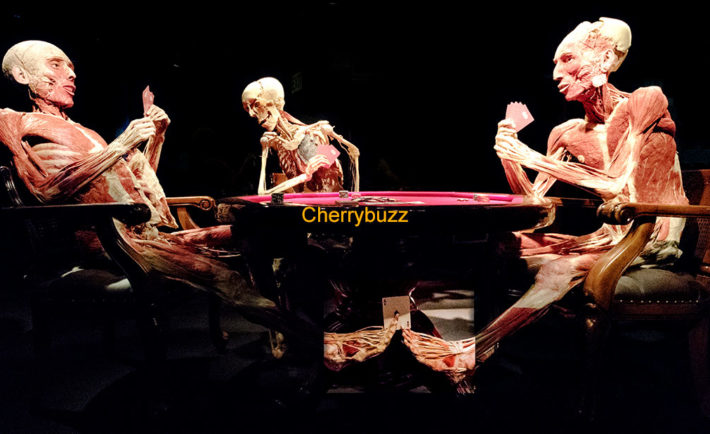
The California Science Center is currently hosting “BODY WORLDS: Pulse” which the Center’s official site calls “the largest Body Worlds exhibition in a decade, with new real human-body specimens”. More than 200 specimens are on display through 20 February, 2018. Adults and children are welcome but parents are advised to read the family guide provided before deciding whether or not to take their children along.

Plastination Technique
Body Worlds exhibitions encapsulate the vision and life-work of Dr. Gunther von Hagens who invented the technique of plastination in 1977 and patented it in the following year. Plastination allows the preservation of animal and humans organs and whole cadavers indefinitely. It has caused much controversy in different parts of the world not only in Germany where von Hagens has been, for 22 years, a lecturer in the Institute of Anatomy and Pathology of the University of Heidelberg. His name at birth was Gunther Gerhard Liebchen, von Hagens being the name of his first wife, the mother of his three children. His second wife, Angelina Whaley, is the Creative Director of the Body Worlds exhibitions. When the exhibition was in London, in 2002, a Guardian newspaper article, in describing The Horseman, which presents a flayed man with open skull holding his brain in one hand and a whip in the other sitting astride a flayed horse, compared the exhibits to the works of Salvador Dali.

Dr. von Hagens in the Media
Dr. von Hagens has been attacked and vilified by numerous individuals and cultural bodies and often in offensive terms. He has been called all sorts of names including Dr. Death, a modern Frankenstein and lots more, his exhibits dubbed ghoulish, shocking and in bad taste. But Dr. Gunther von Hagens not only welcomed controversy, he reveled in it as evidence of his argument that modern humans, especially in the west, lived in denial of their corporeality and of death. He told the Guardian reporter, Stuart Jeffries, that he wanted to “democratize anatomy”, adding that the sight of “cholesterol-crammed aortas, diseased lungs and booze-swollen livers … may well have benefits in terms of public health”. In truth, the Body Worlds exhibitions present Herculean scientific feats made possible only with von Hagens’ discovery of plastination and the dogged determination that devised equipment to make it possible to plastinate whole animal and human cadavers, all of which willingly donated by the living before dying. In 2011, von Hagens revealed that he was suffering from Parkinson’s disease and that, after his death, his cadaver will be plastinated and put on display. His wife and three children are also on the register as donors destined for plastination after death. Plastination is not by any means an easy task; it needs up to 1,500 work hours at a cost of about £25.000 per cadaver and sometimes more. But a Body Worlds exhibition is yet more than a huge learning experience; it is also an aesthetic and creative one as the cadavers are presented in life-like poses reflecting more than a revelation of various structures and systems of animal or human anatomy. Moreover, Dr. Gunther von Hagens’ Institute of Plastination has for decades been supplying medical colleges the world over with whole plastinated cadavers for teaching purposes and also with another of his inventions: wafer-thin slices of plastinated organs and body parts for more refined studies of diseases in the search for new cures.

As always, major human discoveries and achievements attract enormous media attention and Dr. Gunther von Havens is no exception. With the black fedora hat which is always on his head even when he dissects a cadaver, no doubt in imitation of the hat in The Anatomy Lesson of Dr. Nicholas Tulp by Rembrandt, now housed in the Mauritshuis Museum in The Hague, the Netherlands, von Hagens has cut a remarkable figure on various TV and radio programs and has even appeared briefly in a Bond movie. The 2006 Casino Royale supposedly shows a Body Worlds exhibition taking place in Miami and von Hagens can be seen, fedora hat and all, leading a tour of the exhibition. The actual location was not Miami though but the Ministry of Transportation in Prague!.
Body Worlds Exhibits
The aesthetic/creative presentation of the exhibits at a Body Worlds exhibition usually start muted but build up to a crescendo at the end with the highly emotional and tragic plastinated cadaver of an eight-month pregnant woman with her womb open revealing the equally dead and plastinated fetus inside.
There are thousands of registered body donors to the institute of Von Hagen’s institute for Plastination in Heidelberg, Germany who are from different countries over the world including USA. The Plastinarium is a permanent exhibition in Guben, Germany.
In 2004 Body Worlds exhibit in California Science Center was seen by more than a million visitor. The “Body Work” exhibit is till on display until February 20, 2018. So if you have not seen it yet, you still have the chance to see that unique exhibit.

For more information please refer to the following links:
californiasciencecenter.org
www.vonhagens-plastination.com
Wikipedia
The Guardian: Stuart Jeffries: The Guardian: Tuesday 19 March, 2002