Your cart is currently empty!
Category: Science
-

The Invisible Light: Infrared & Ultraviolet Photography
To understand these techniques & use them successfully, we need first to understand the light spectrum. The colors the naked human eye normally sees, which range from violet to deep red, form a small part of it; they occupy light wavelengths ranging from around 380 nanometers (nm) to 750 nm. Wavelengths which are shorter become Ultraviolet and those which are longer become Infrared. All the photos that we have taken so far in our capacity as amateur or professional photographers, from when the camera was first invented (1816) up to recent days, have utilized that small part of the light spectrum. From black and white images (1826) the move to color photography (1861) was hailed as a great improvement, which indeed it was. But nowadays, creativity has moved far beyond that and modern technology is opening ever wider doors into realms undreamed of before. When technology weds art, the result becomes utterly fantastic and even unearthly! This is what Infrared (IR) and Ultraviolet (UV) photography is all about. It allows photographers to capture what the naked eye cannot see and what ordinary cameras are not designed to capture. In fact, cameras are normally fitted with filters to screen off those wavelengths.

This brings us to what you need in order to get the results you seek to achieve with Infrared and/or Ultraviolet photography. Short of buying a new camera, one easy & inexpensive solution is to acquire a filter to place in front of the lens of the camera you already have. After experimenting with it and once you are convinced that this is the way forward for you, you can have your camera converted to the technique you desire. It will cost you but will still be less expensive than an outright new camera. The only snag is once converted there is no way back; your camera cannot revert to its old practices.

Infrared photography began in the early years of the 20th century and proved very useful during WWI and later in WWII as well. But it was the introduction of digital cameras in the late 1990s that weighed decisively in favor of these modern techniques. Infrared photos are easily recognizable by their eerie and otherworldly glowing whites and jet-black contrasts or by their strange colors. Because it reveals what the eye normally cannot see and in quite strong contrasts, infrared photography has proved itself extremely useful in forensic investigations. In the film industry, it is responsible for numerous surreal or otherworldly effects. When IR photography is used, almost everything looks extremely different from what it looks like within the visible light spectrum and, in short, this is what constitutes its magic. One good piece of advice, however, is to remember always that living entities, trees, foliage or a butterfly, reflect a greater amount of infrared light than inanimate objects such as concrete walls or mountains.

Ultraviolet photography uses light from the Ultraviolet (UV) spectrum only. “There are two ways to use UV radiation to take photographs – reflected ultraviolet and ultraviolet induced fluorescence photography.” The first is most useful in medicine, especially dermatology, in botany and in forensic investigation etc. The sun is the source here, a natural source which is readily available, except on cloudy or rainy days. But UV induced fluorescence photography must take place in a darkened room. In this case, it is not enough to use a filter, as in infrared photography. The camera must be modified, and UV capable lenses must be fitted.

Ultraviolet photography gives fascinating results especially with flowers and insects. It reveals in flowers, for instance, patterns hidden from the human eye but seen only by insects who are being attracted as pollinators. This is like opening new doors of perception, allowing us, humans, to experience the world around us in ways never explored before. It allows us literally to have a bird’s or an insect’s eye view of the world around us.

Using this technique, some photographers have certainly produced photos that are stunningly beautiful thereby transforming ordinary blooms into things out of this world. One such photographer is Craig Burrows who lives and practices in Southern California. According to Craig, flowers, plants and leaves are all naturally fluorescing when exposed to sunlight, but the naked eye cannot see that because of the intensity of the reflected visible light. In other words, ultraviolet photography is giving us a truer view of the flowers than our eyes can give us. Truth, trick or art, whichever way you look upon it, the results are breathtakingly beautiful even without any photo processing as switching color channels.

For more information, please see the following links:
https://www.amateurphotographer.co.uk/technique/camera_skills
article by Alex Morrison at https://digital-photography-school.com/how-to-do-surreal-digital
Using Ultraviolet Light to Make Nature Fluorescence in Photos by Don Komarechka in https://petapixel.com/2017/09/21/using-ultraviolet-light
article by Dunja Djudjic at https://www.diyphotography.net/photographer-takes-photos-flowers
wikipedia
-

2019 Lunar Eclipse Super Blood Wolf Moon
In August 2017, we treated out readers to an article and wonder-striking photos of a total Solar Eclipse. That was an unmissable spectacle for millions of people of all ages.
The January 20th, 2019 Super Blood Wolf Moon has promised and delivered a no less amazing spectacle. But before we continue, it is well to explain briefly what the longish name means.
A Super Moon is a moon at its closest distance from Earth, which in astronomical jargon is to say when the moon is at the Perigee. Being over 30,000 miles closer than it is at its farthest point away, the moon appears up to 14% bigger and 30% brighter than at other times of the year. This is much enhanced if when the moon is at Perigee it happens also to be a full moon. Unfortunately for many of us, this might not always be seen with the naked eye due to adverse weather conditions and/or light pollution in most major cities. But weather and other factors permitting, it is a dazzling spectacle!.
Super Moons, in themselves, are quite common though. There have been four (4) in 2018 but only one of them coincided with a full moon. Apart from other celestial phenomena, such as the spectacular meteor shower earlier this month, our moon this month (on January 20th in the US) coincided with a full moon. Furthermore, what made this January Super Moon a more interesting and rare occurrence is indicated in the remaining details of the name. The ‘Blood’ part marks the fact that the Super Moon seems to glow red as it emerges from a total lunar eclipse. Lunar eclipses are not uncommon; three (3) lunar eclipses were seen in various parts of the world in 2018. NASA, however, reckons that after this January Lunar Eclipse there will be no other total lunar eclipses till May 2021.
Moreover, what makes this eclipse rare is the fact that it coincided with a Super Moon. As the three celestial bodies, Sun, Earth and Moon, became perfectly aligned, the light refracted from the Earth’s air threw a reddish hue onto the face of the Moon. This is because the Earth’s atmosphere scattered all the short-wavelength light (in colours like green or blue) and left only longer-wavelength light which comprise the redder end of the spectrum. Hence the name: Blood Moon. It is good to remember that, unlike Solar Eclipses, which you need special protective goggles for, Lunar Eclipses are safe to look at with the naked eye.
The ‘Wolf’ part of the name goes back to Native American traditions from days preceding the use of solar calendars. Lunar calendars used different names for the months and were closely linked to people’s observations of their natural surroundings. Native Americans called the Full Moon in mid-winter Wolf Moon because of the all too frequent howling of hungry wolves out in search of food.
To witness all three phenomena in one go is what made this January 2019 Super Blood Wolf Moon a rare and indeed unmissable experience. Millions upon millions of people in North and South America, parts of Western Europe and Africa were able to catch that rare sight overnight on Jan 20 into Jan 21. It is pertinent here to note that the longest possible lunar eclipse is 1 hour and 47 minutes and that the longest total lunar eclipse of the last century, which occurred on July 16, 2000, lasted 1 hour and 46.4 minutes. This time (20/21 Jan. 2019) it did not last as long (only 1 hour and 2 minutes) but was no less spectacular!.
Unfortunately the viewing conditions based on weather were poor on the western half of the US ON Sunday 20, 2019. Few hours later, the sky became clear.

For more information, please visit the following links:
- https://www.nationalgeographic.com/science/2019/..
- https://inews.co.uk/news/ science/super-blood-wolf-moon-lunar-eclipse ..
- https://www.foxnews.com/science/rare-super-blood-wolf-moon-eclipse ..
- https://www.countryliving.com/wildlife/..
- https://news.sky.com/story/lunar-eclipse-rare- …
- https://www.theweathernetwork.com/news/article/winter-sk..

-

Technology & Butterflies
 Butterflies are such stunningly beautiful and delicate creatures that they are sometimes used as a point of reference denoting beauty, colorfulness & the ephemeral. It is a less known fact to many butterfly lovers that some species of those delicate colorful winged creatures, the North American Monarch for example, actually migrate up to 4830 miles (7,778 km) to overwintering sites in Mexico!. Such migratory feats are rare in insects except perhaps for desert locusts (Schistocera gregaria) which have been on record (notably in 1950) as making the journey from the Arabian peninsula over 3,106 miles (5,000 km) to the west coast of Africa in seven weeks!. One tagged monarch in Lincoln, Nebraska, was recovered in Paulina, Iowa, after having covered 158 miles in 18 days!.

But apart from their beauty and delicateness, what is marvelous & intriguing about butterflies is the shimmering iridescence of the colors on their wings. The vibrant colors also change in intensity depending on the butterfly’s movement and the angle of viewing. This is because that shimmering color is not due to pigments but to tiny three-dimensional structures which cause the way light is reflected to change. Sarah Knapton, the Telegraph science correspondent, wrote about a scientific break-through which Professor Andrew Parker of the Natural Museum in London reported upon. The shimmering colors, said the Professor, ” are not caused by pigments or dyes but materials with a Nano-structure. And they last for a long time. We have dug up 49 million year old beetles and they are still the same color that they were when they died”. The article goes on to assert that Prof Parker & colleagues successfully cultured, in the Natural Museum Laboratory, an entire blue morpho butterfly forewing from cells dissected from the chrysalis.

The implications of discovering colors that never fade are enormous not only for the construction industry but for textile, the automobile & numerous other industries. Research might have gone on for years at a slow pace but one technological innovation gave scientists a mighty helping hand. This is the Crisper-Cas gene editing technique; it has enabled researchers to find out exactly what a gene does by deleting it & observing what happens or by giving it a twist & again observing the results. The great expense and elaborate steps of earlier gene editing procedures were prohibitive but Crisper is a fairly easy & relatively inexpensive tool empowering researchers in utterly new ways. Hence the leaps & bounds that research, in this area, has shown in recent years. Thus we see in a report in The Proceedings of National Academy of Sciences that two teams of biologists have used the technique to explore two master genes which control the ways in which butterfly wings appear to us. The master genes in question are those called optix & WntA. Research on these two master genes has not only rendered results for understanding butterfly wings but has also revealed that master genes that control the activity of other genes can evolve different roles in different species. The experiments & research continue with huge implications as well as hopes of finding answers to key questions in evolutionary biology.

As noted before, the economic & industrial implications of these researches are immense & wide-ranging. From an artist’s tool, as in the case of Kate Nichols, this gave rise to a scientific ambition to make Nano-structural materials that would give bright shimmering iridescent colors which not only do not fade but also are water resistant like butterfly wings. The next step was realized by a research group at Pennsylvania University. The research group succeeded, as far back as 3012, in making a new material which might also contribute in the future to energy-saving devices that automatically adjust the heaters and air conditioners inside smart buildings. On the outside of a building, such materials will not only provide bright, iridescent colors pleasurable to the eye but will also cancel the need for ever needing to re-paint the building or even clean it since structural colors also resist dirt, damp & mildew. It is pertinent to note that although the surface of structural materials or paints is rough, that roughness is not detected by the touch because the component structures are minuscule. The group was successful in giving their material the ridges necessary for structural color as well as the roughness necessary for water proofing; it only remains to make the processes less expensive & as that achievement has been made in 2012, future smart homes are now probably around the corner.Kate Nichols, an artist who has been using Nanoparticles in her paintings for years, traces the inception of her art back to her fascination with the blue-green iridescent hues of the Morpho butterfly. Because the color is not made of pigments but of structures which are smaller than a single wavelength of light, they “redirect and slow light waves down, causing them to interfere with each other in ways that depend on the shape, size, and spacing of the scattering structures, as well as on the angle of the incoming light and the position of the observer. In the case of the Morpho, these structures scatter blue light most strongly; its hue shimmers and shifts to lighter or darker blue as the butterfly moves, producing iridescence. Structural color is also at work in peacock feathers, fish scales, and beetle casing. Morpho butterflies and peacock feathers have also been behind the invention of new color printing techniques by researchers at the Technology University of Denmark. As this technology uses high resolution of 127,000 dots per inch, it can be used to print security patterns or watermarks on passports or bank notes which would make it impossible to counterfeit.

For more information, you may visit the following links:
https://en.wikipedia.org/wiki/Butterfly
http://www.pressreader.com/uk/the-daily-telegraph/20160827/281672549367295
https://www.nytimes.com/2017/09/18/science/butterfly-wing-color-patterns-gene-editing.html
https://www.katenicholsstudio.com/
https://gizmodo.com/this-artist-paints-with-nanoparticles-inspired-by-but-1746583925
http://blog.drupa.com/en/butterfly-wings-and-bird-feathers-inspire-new-color-printing-technique-2/
-

BODY WORLDS: Pulse Exhibition at the California Science Center
The History of California Science Center
A visit to the California Science Center, at Exposition Park, Los Angeles, is at once amazing and breathtaking as well as highly enlightening for children and adults alike. That part of Los Angeles has gone through one transformation after another from the days when, from 1872 to 1910, the site held open agricultural fairs till the California State Exhibition building was erected in 1912. In those early days, the building displayed agricultural and industrial products. But it was in 1951 that it became the California Museum of Science and Industry. Then in the late 1980’s an ambitious 25-year plan was devised for a much larger facility to be renamed the California Science Center. The Northridge Earthquake of 1994, which damaged the building, put a keener impetus on the plan and the building was closed in 1996.
The first phase of the plan was completed and the Center was opened in 1998. New wings and extensions have been accomplished and now the California Science Center not only has galleries with exhibits on continuing loan from NASA and the Smithsonian Institution, it also boasts a seven-storey IMAX screen and the Wallis Annenberg Building for Science Learning and the K-5 Science Center School officially known as Dr. Theodore T. Alexander Jr. Science Center School. The California Science Center, the largest hands-on facility on the West Coast, is jointly owned and run publicly and privately by the State of California and the California Science Center Foundation.
BODY WORLDS: Pulse Exhibition
The California Science Center is currently hosting “BODY WORLDS: Pulse” which the Center’s official site calls “the largest Body Worlds exhibition in a decade, with new real human-body specimens”. More than 200 specimens are on display through 20 February, 2018. Adults and children are welcome but parents are advised to read the family guide provided before deciding whether or not to take their children along.

Plastination Technique
Body Worlds exhibitions encapsulate the vision and life-work of Dr. Gunther von Hagens who invented the technique of plastination in 1977 and patented it in the following year. Plastination allows the preservation of animal and humans organs and whole cadavers indefinitely. It has caused much controversy in different parts of the world not only in Germany where von Hagens has been, for 22 years, a lecturer in the Institute of Anatomy and Pathology of the University of Heidelberg. His name at birth was Gunther Gerhard Liebchen, von Hagens being the name of his first wife, the mother of his three children. His second wife, Angelina Whaley, is the Creative Director of the Body Worlds exhibitions. When the exhibition was in London, in 2002, a Guardian newspaper article, in describing The Horseman, which presents a flayed man with open skull holding his brain in one hand and a whip in the other sitting astride a flayed horse, compared the exhibits to the works of Salvador Dali.

Dr. von Hagens in the Media
Dr. von Hagens has been attacked and vilified by numerous individuals and cultural bodies and often in offensive terms. He has been called all sorts of names including Dr. Death, a modern Frankenstein and lots more, his exhibits dubbed ghoulish, shocking and in bad taste. But Dr. Gunther von Hagens not only welcomed controversy, he reveled in it as evidence of his argument that modern humans, especially in the west, lived in denial of their corporeality and of death. He told the Guardian reporter, Stuart Jeffries, that he wanted to “democratize anatomy”, adding that the sight of “cholesterol-crammed aortas, diseased lungs and booze-swollen livers … may well have benefits in terms of public health”. In truth, the Body Worlds exhibitions present Herculean scientific feats made possible only with von Hagens’ discovery of plastination and the dogged determination that devised equipment to make it possible to plastinate whole animal and human cadavers, all of which willingly donated by the living before dying. In 2011, von Hagens revealed that he was suffering from Parkinson’s disease and that, after his death, his cadaver will be plastinated and put on display. His wife and three children are also on the register as donors destined for plastination after death. Plastination is not by any means an easy task; it needs up to 1,500 work hours at a cost of about £25.000 per cadaver and sometimes more. But a Body Worlds exhibition is yet more than a huge learning experience; it is also an aesthetic and creative one as the cadavers are presented in life-like poses reflecting more than a revelation of various structures and systems of animal or human anatomy. Moreover, Dr. Gunther von Hagens’ Institute of Plastination has for decades been supplying medical colleges the world over with whole plastinated cadavers for teaching purposes and also with another of his inventions: wafer-thin slices of plastinated organs and body parts for more refined studies of diseases in the search for new cures.

As always, major human discoveries and achievements attract enormous media attention and Dr. Gunther von Havens is no exception. With the black fedora hat which is always on his head even when he dissects a cadaver, no doubt in imitation of the hat in The Anatomy Lesson of Dr. Nicholas Tulp by Rembrandt, now housed in the Mauritshuis Museum in The Hague, the Netherlands, von Hagens has cut a remarkable figure on various TV and radio programs and has even appeared briefly in a Bond movie. The 2006 Casino Royale supposedly shows a Body Worlds exhibition taking place in Miami and von Hagens can be seen, fedora hat and all, leading a tour of the exhibition. The actual location was not Miami though but the Ministry of Transportation in Prague!.
Body Worlds Exhibits
The aesthetic/creative presentation of the exhibits at a Body Worlds exhibition usually start muted but build up to a crescendo at the end with the highly emotional and tragic plastinated cadaver of an eight-month pregnant woman with her womb open revealing the equally dead and plastinated fetus inside.
There are thousands of registered body donors to the institute of Von Hagen’s institute for Plastination in Heidelberg, Germany who are from different countries over the world including USA. The Plastinarium is a permanent exhibition in Guben, Germany.
In 2004 Body Worlds exhibit in California Science Center was seen by more than a million visitor. The “Body Work” exhibit is till on display until February 20, 2018. So if you have not seen it yet, you still have the chance to see that unique exhibit.

For more information please refer to the following links:
californiasciencecenter.org
www.vonhagens-plastination.com
Wikipedia
The Guardian: Stuart Jeffries: The Guardian: Tuesday 19 March, 2002

-

HOW TO TRAVEL IN SPACE WITH ADVANCED TECH
The world we live in today is one that is advancing tremendously. Specialists in the science world are now devising new means through which rockets and satellites can travel into space. Initially, people needed a whole lot of fuel to be able to send their rockets into space. But with the newly discovered method by scientists, it is now easy to launch your satellites into space with the aid of solar energy. Yeah! You heard right. It is now possible to travel into space through plasma communication.
Most of the air organizations including NASA have had to face severe budget prune due to global economic meltdown and so this new development comes at the right time because people no longer have to consider burning down lots of fuel before they can send their satellites and rockets into space.
There are so many benefits that will be derived from the use of this new technology and these are:
- For the communication field, it is now possible for the most undeveloped areas in the world to gain access to Telephone and internet connectivity.
- It is also going to be useful in the finance world if investors can be willing to make a large investment for its quick implementation.
- In the business world, it is also useful because it now enables you to be able to get your products and services to the front of a larger audience.
- And personally, this new technology is very beneficial because you can now stay in contact with your friends and family no matter where they are anywhere in the world. And if you are a professional in space technology, you can now monitor your business, friends and family members at a relatively low-cost which is the sun.
Apart from the ones discussed here, there are also many numerous opportunities that you can take advantage of with space tech and now is the time to take that action.
-
Scientific reasons why you should not be pretty
As you grow up, discover the world, your true potential in life and all that.. Life keeps proving that luck is only granted to good looking people! Pretty girls and handsome men gives what people call good 1st impression. Hundreds of magazines, human development books, courses, clinics are completely devoted to only enhance people’s appearances. All top models/celebrities are skinny, tall, nice hair, nice skin,..
But wait a second, here I can give you five scientific reasons why you should not give a damn and it’s good not to be pretty.
I mean by pretty here, is the form everyone trying to resemble, let me tell you something, there is no ugly people – for real!
.Big noses are good for your health – No kidding!
Size and the shape of noses are always a big topic, people are always concerning themselves with it’s size and how it looks in pictures and mirrors, more than 50,000 rhinoplasties are done per year in the United States. Which is a big number, relatively.
But the thing is, researchers say it is more healthy to have a big nose than a small one, bigger noses give you protection against bacteria and infections. An experiment was carried out, researchers made two artificial noses, one of them 2.3 times the size of the other. They found that the bigger nose inhaled 6.5 percent fewer particles. The result was positive regarding big noses.
Do you have a big nose? You are a survival.

“after the shoot” by Sarah Stierch is licensed under CC BY-SA 4.0 They say people with big noses are interesting “They are given character”.
.Short people live longer.
Scientific studies have showed a direct connection between short height and long life.
Short men were found to live longer than taller people since they carry a gene that protects them from the effects of aging.
Past studies have examined the relationship between height and lifespan of populations around the world, assuming that taller people generally live shorter lives,
Remember legrooms in airplanes will never be an issue.

“Young and Fat” by Tony Alter is licensed under CC BY 4.0 .Fat people don’t break.
Thijs R. Klompmaker of the Netherlands, well known by “Wai Genriju” believe that fat people have better bone health than thin people, as they tend to have elevated levels of the leptin Hormone.
So fat people are more likely to have better bone health than thin people! If you are fat, you are not supposed to be broken easily!
Fat is the new sexy
Most people look alike by away or another, through fashion trends, Gym, diets.. Even though it is not wrong to work hard to look good on the outside but you have to know clearly that there are things that shapes your character.
Embrace your natural looking, put confidence in it and eventually you will be charismatic and pretty. Turn the table around and be a new possibility and express beauty by your own language. Or you can just ignore these words of wisdom because they are so common and just do whatever you want!
Advice of the week: Darkness sometimes has its bright side too.
-
10 interesting facts about humans brain
10 interesting facts about humans brain
Since everyone will be reading this will be a human, its time to learn more about yourself and your species. Like small part of you as your brain can hold life wonders and you just don’t know it. There is no wonder that the brain is one fascinating and incredible organ, many scientists question if we will ever figure it out? Since many researchers and doctors have devoted their entire lives to understand how it works! And till this very moment many of these questions haven’t been fulfilled about the human’s brain, it is very complicated indeed.
So did you know that..

“synapse” by Allan Ajifo is licensed under CC BY 4.0 1.The brain feels no pain.
Even though the brain acts as the central command for the central nervous system, it has no one pain receptor, it is the only organ in the human body that lacks nerves. This part of your body can feel no pain!
2.The brain consumes energy more than you think.
The human brain consumes the largest portion of the total energy that is generated in the human body. the brain consumes 20% of that energy even though it only represents 2% of the total body weight. The energy is vital and essential for maintaining healthy brain cells and pumping nerve impulses.
3.Your brain is fat, no offense.
The human brain is the fattest organ in the body and may consists of at least 60% fat!
4.You are bigger than the world.
Number of neurons inside of the brain determines the speed of the processing ability of your brain. So did you know that the number of neurons present in the brain is approximately 100 billion which is about 15 times of the total human population on earth!
5.Your brain never ages.
Actually your brain stop growing at the age of 18.
6.Brain misusing.
There are many quotes and people say that we human beings use less than 10% of our brain. This is not mainly true because brain functions at many scales and each part of the brain has a known function. Doesn’t ignore the fact that there are some people who don’t use it at all!
7. Shaping Emotions.
The capacity for emotions such as happiness, sadness, fear and shyness are already developed at birth. The specific type of nurturing a child receives shapes how these emotions are developed. Better watch out for what your kids are receiving.
8.Let’s burn the house.
The energy consumed by your brain is sufficient enough to illuminate a light bulb! The brain consume energy approximately 25 watts.
9. No one is perfect, even your brain.
Our brain is not perfect as many think, so often it has been found to fool us, making us perceive things differently from reality.
10.High temperature is not enough to kill you.
Next time you get a fever, keep in mind that the highest human body temperature ever recorded was 115.7 degrees.
NB: The man survived.

“98 Degrees” by Ray Bodden is licensed under CC BY 4.0 Can you imagine that the brain we have been talking about up there is you? You hardly know how things work inside of us and what are the drives of our dreams, hopes, thoughts, guesses,etc..
It is indeed an interesting topic, stay tuned for more articles..
-

SYNESTHESIA is not sickness – It is beautiful brain malfunction
SYNESTHESIA is not sickness – it is beautiful brain malfunction
“She has that displacement of the senses which others take drugs to find. So she is like a lover of rock who sees vibrations when she hears sounds.“
That’s what Norman Mailer said about Marilyn Monroe in his book
You might not believe me but Marilyn Monroe was sick! she had “ SYNESTHESIA “.
Synesthesia is a neurological anomaly in which stimulation of one sensory system simultaneously stimulates another system, making it one of the rarest anomalies on earth! It means people with synesthesia can taste notes, hear colors or smell days!
Why am bringing this up now ?
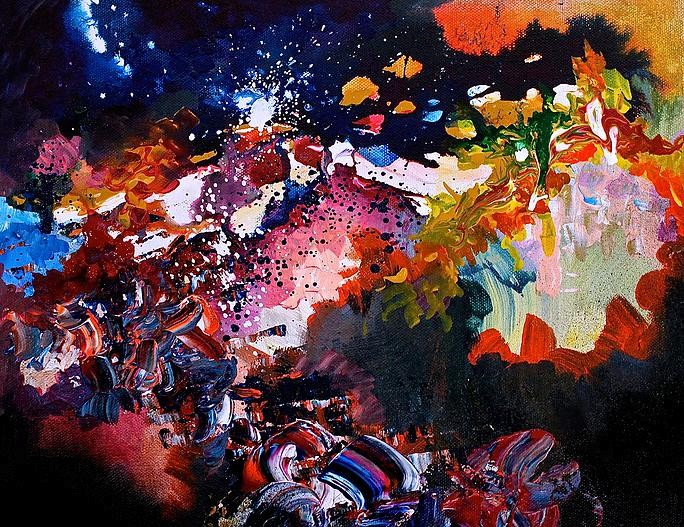
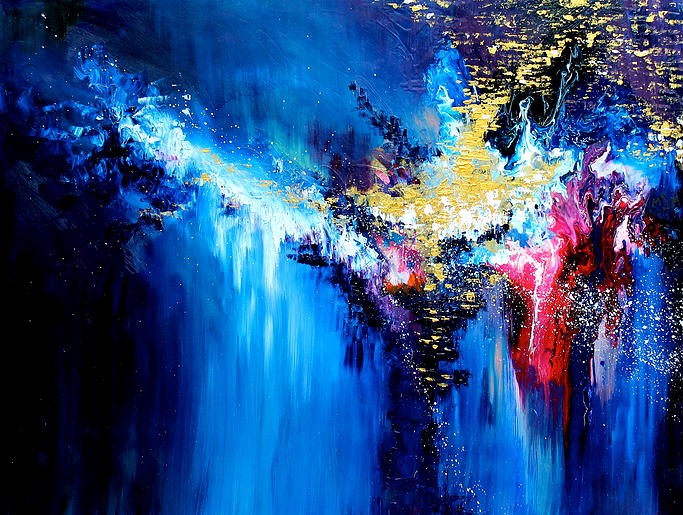
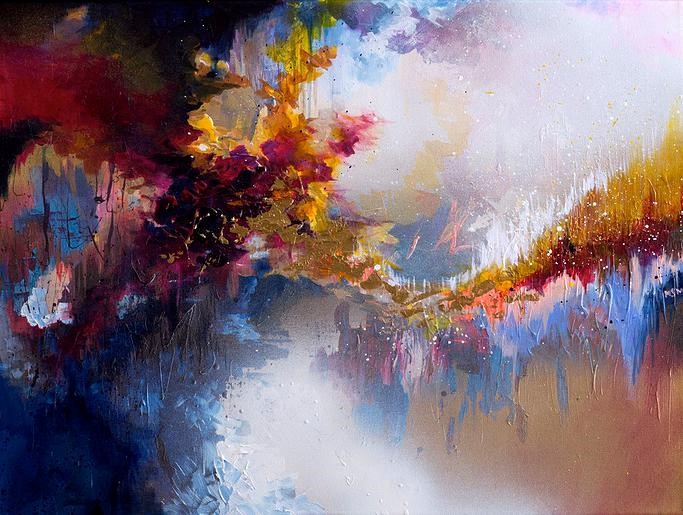
Because a very special artist decided to paint what she sees .
Well, decided to paint the music she sees!Melissa s. McCracken ‘s website front page
“But the most wonderful “brain malfunction” of all is seeing the music I hear. It flows in a mixture of hues, textures, and movements, shifting as if it were a vital and intentional element of each song. Having synesthesia isn’t distracting or disorienting. It adds a unique vibrant to the world I experience.“
Being able to actually SEE music in action , colored and moving vitally around the place , shifting and changing its texture and patterns, had given Melissa a sensation privilege allowing her to produce some magnificent pieces of arts
Did you ever think how Karma Police for Radio head will look like if it was a paint ?Well that’s how Melissa sees it :

Or what about the beautiful “ At Last “ when sung by Etta James, well better seen than heard!

“Imagine there’s no heaven, It’s easy if you try
No hell below us, Above us only sky!
Imagine all the people, Living for today… “
John Lennon people, John Lennon
If you want to see more stunning art works you definitely have to pay Melissa’s website a visit!
But WAIT, we are not done here yet
You might say : “Oh, ok that’s good but still, there are not a lot of synesthetic artists out there, why make a deal out of it when it’s only one of a kind?“
Do You know who else have ‘’music to color ‘’ synesthesia?
This man: HappyYes, That’s RIGHT!
He said in Nightline interview “It just always stuck out in my mind, and I could always see it. I don’t know if that makes sense, but I could always visualize what I was hearing… Yeah, it was always like weird colors.”
Do you know Charli XCX? of course you do! who didn’t watch the fault in our stars and cried himself to sleep, Charli is synesthetic!
Want to get more surprised?Kanye west has ‘’Music to color ‘’ synesthesia too !
Actually synesthesia is not exclusive for artists and it’s not ‘’Music To Color‘’ type only.
there’s Richard Feynman, the great scientist. He had “graphemes to color “ synesthesia, meaning he always saw letters and numbers in colors.
Vladimir Sirin, American-Russian author – known for his most famous novel ‘’ Lolita ‘’ – had “graphemes to color “ synesthesia that affected most of his works.
After all, synesthesia is a fascinating neurological condition that opens the minds for new and very different experience and we definitely envy those who have it! So the next time your friend tells you that Mondays are blue, pay attention, he might be seeing something you can’t realize!Image credit: Melissa S McCracken