Your cart is currently empty!
Author: Editor
-
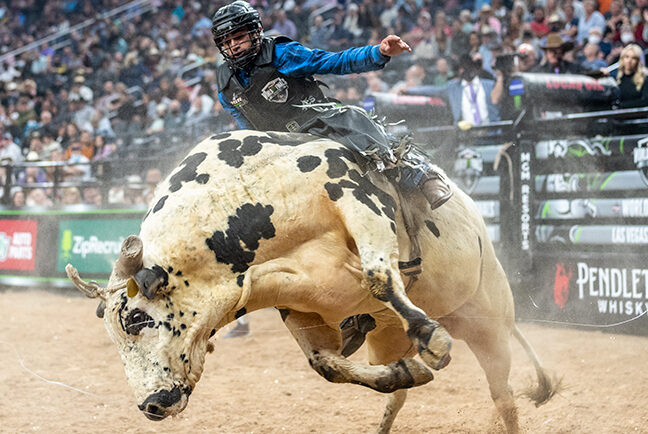
PBR 2021 World Finals XXVIII – Day 3
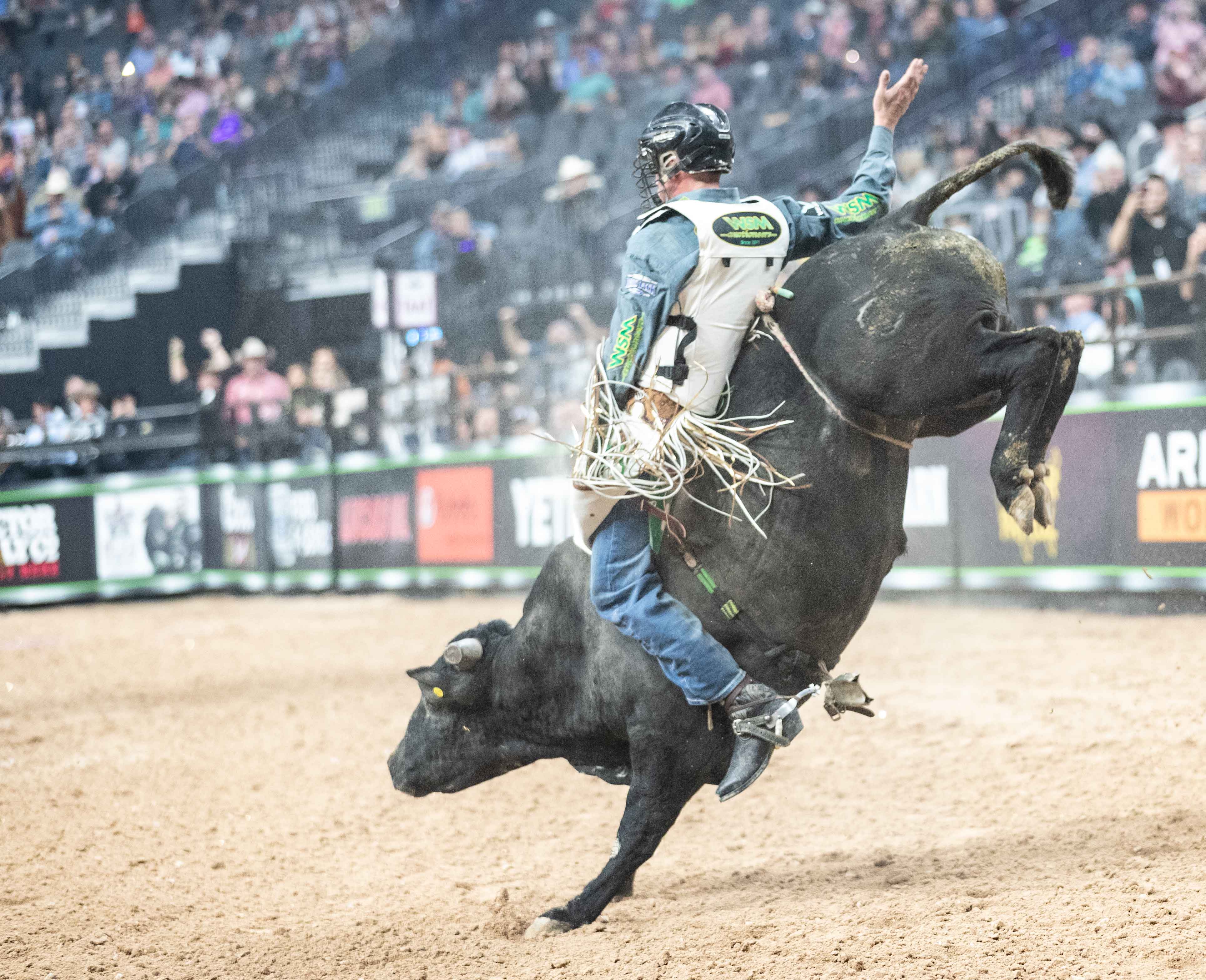
 One needs to remind oneself that the ride astride the bucking bull lasts only eight (8) seconds, yes a small fraction of a minute! But most athletes will tell you that these are like no other eight seconds! The adrenal rush of trying to remain seated on the fiercely bucking beast while holding the riding rope with one hand & without touching the bull or oneself with the other is immense & is often felt by the cheering spectators!

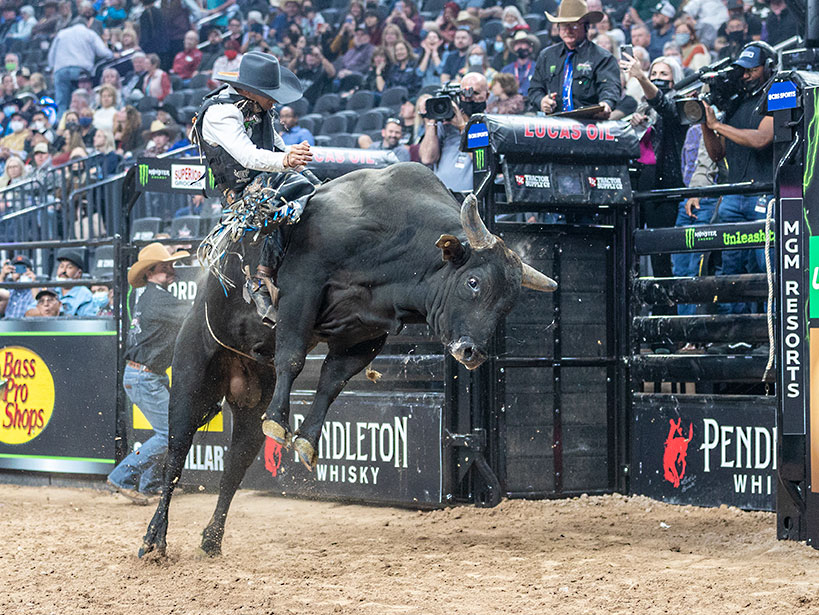
The exhilaration of those eight seconds together with the joy of winning as well as, no doubt, the big money involved all make athletes return to the arena even after sustaining injuries! Thus we see, for instance, Austin Richardson taking part in the Pendleton Whisky Velocity Tour championship only twenty-four days after surgery for a broken collar bone!
 Mason Taylor came in first place in round 3 and the competition contiues.
 -
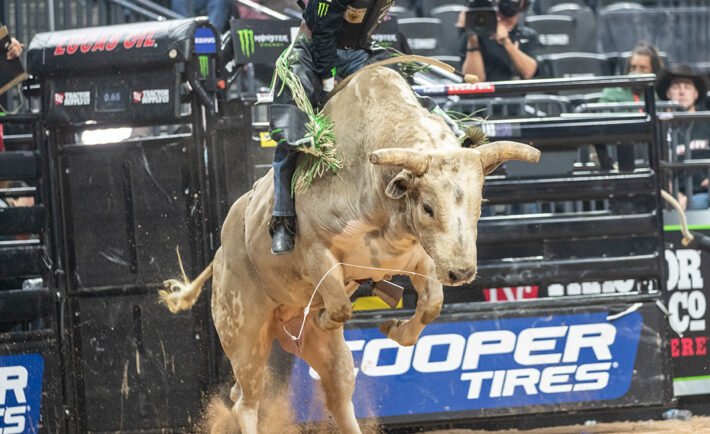
PBR 2021 World Finals XXVIII – Day 2
 Over & above the attractions previously mentioned, there are ‘Mechanical Bull Competitions’, sessions when besides the ‘Rider Meet & Greet’, a fan can have his/her favorite Rider sign him/her a souvenir. A Western Gift Expo is there on hand for all the gifts one might desire for family & friends. There is the Pendleton Whisky Concert Series and lots and lots more all in a memorable week in Las Vegas, Nevada!
 This time round, there is also a new feature: four bucking bulls coming all the way from Alberta’s Foley outfit are taking part. They are: Fogo, Ceilis Pyper, Road Rash and Nasty Cherry. There are other world famous bulls, such as Woopaa, Chiseled, Little Yellow Jacket and many more. Like Riders, Bulls also have their fans and may the best win at the end.At the end of round 2 , Chase Dougherty is on top and the exciting finals continues.Here highlights of round 2.


Press Conference After Round 2 -
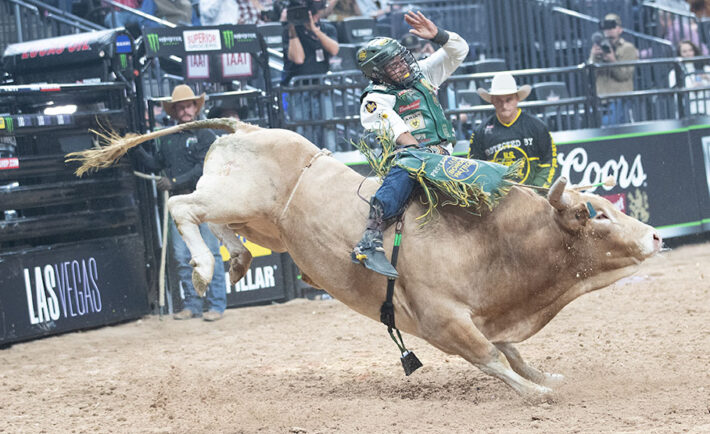
2021 PBR World Finals XXVIII – Day 1
At long last, after the disruption caused by the Pandemic, Las Vegas is once more hosting the PBR World Finals: Unleash The Beast (3-7 November, 2021). The Finals have been most eagerly awaited both by the participants and the fans all over the world. This is no doubt the best contest where Man’s will, dexterity, agility and brain tactics are pitted against the sheer brute force of the bucking bull! As such the contests attract innumerable millions of loyal followers who, if not lucky enough to attend in person, will be glued to the screen.
Taking part are many of the most famous names in the sport: e.g. Cooper Davis, Jess Lockwood, Cody Jesus, Daylin Swearingen, Robson Palermo and many more. Besides the actual contests, there is also lots more fun for those attending in person. There are numerous behind-the-scenes tours & chances for close-up photos with the Riders and also the bulls. There are the extremely popular shows like Flint’s Outside the Barrel Stage Show and plenty more
Eli Vastbinder scored the highest score in the first night. here are some of the round 1. Here are high lights of Round 1


-

2019 PBR World Finals XXVI, Round 2
 Tonight, 2019 PBR World Finals XXVI continues in round 2. Bull riding is perhaps the fiercest and most grueling of sports, especially when we consider that the test of a competitor’s skill requires no more than to hold on and ‘stay put’ for a mere eight seconds! But these are indeed eight seconds like no other when the staying put is on a bull bucking like mad to get the unwanted rider off its back! Depending on the rider’s prior experience and level of training as well as skill, those eight seconds are bound to feel very different from any other. They might well feel like eighty seconds not eight!
Bulls
After all, this is the ultimate contest between the sheer brute force of the beast (weighing on average over 600 kgs with some bulls weighing a colossal 995 kgs) and the human brain of the rider! No amount of physical strength, prowess or agility serves the rider in such contests as much as his wits. To ensure success, he needs above all to forestall the movements of the beast and out-maneuver it. The difficulty is compounded by the fact that the rider, holding the fiercely bucking bull by the rope in one hand, must not at any time touch himself or the bull by the other free hand.

Bull Breeding
Bull breeding is a lucrative business in its own right but is more so now than ever before, with developments in the science of genetics playing a significant role! Some are already grumbling about the unfair advantage it gives the bulls over the riders! In the past after contests, winning bulls were simply retired to stud farms. Now over and above natural breeding, their sperm is on offer for sale while some have even been cloned! A sperm specimen from a world-wide famous bull like Bushwacker, for instance, sells for up to $3,000; the arithmetics become all the more staggering when one learns that as many as 300 samples can be collected in one session! A promising bull can sell for anything between $50,000 to $250,000! According to the Professional Bucking Bull Association, the industry has grown by 500 percent. “Entry fees are up, and prices are ten times higher than they were ten years ago”. Prize money has likewise shot up to the skies; the top winners this year will scoop two millions!.
Here are some highlights of this round:


Cody Jesus Round 2 results:
- Cody Jesus
- Eduardo Aparecido
- Cody Teel
For more information please see the following link:
https://www.pbr.com/results?eventId=168701&season=2019
-
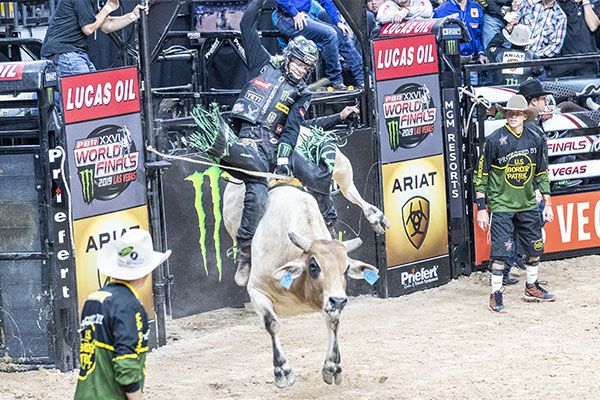
2019 PBR World Finals XXVI
History
Before we present the adrenaline charged action of the PBR 2019 World Finals, in T-Mobile Arena, Las Vegas, Nevada, USA, we ask our dear readers’ permission to give a very brief bird’s eye view of what is at stake by way of starters. For our regular followers, this will enhance the excitement and whet their appetite for the pleasures of the coming events, the awaited four-day main course to be followed by a fifth of announcement of winners & celebrations. For those who are new to the sport, it introduces a few pieces of necessary information.
This year’s PBR World Finals XXVI contests are number 26 as the Latin numerals indicate. Twenty-six years ago, in 1992 to be precise, twenty American Rodeo athletes provided $1000 each and set up the professional body that organized and arranged the bull-riding contests which evolved into to-day’s World Finals. $20,000 may seem little by to-day’s standards but, in its day, was a hefty sum not to be sneezed at. Nowadays professional bull-riding is a multi-million dollars sport drawing athletes and fans not only from the two Americas but from all over the world. The contests are watched by new and veteran fans who cross continents and oceans to attend in person. Millions more watch the action on tele, with many networks airing the events; others watch the action on tablets or other smart devices.
The Competition
Bull riders are usually clad in traditional cowboy outfits with protective vests made of special high quality foam to lessen the impact of a fall, if one occurs, and leather chaps to protect the legs and thighs. To protect against rope burn, a rider also wears a leather glove on the hand that holds the rope. Mouth guards are optional on the professional level. Cowboy hats are the norm but wearing helmets is on the increase among adult riders. Young riders, that is those under 18 years of age, have to wear helmets and facial ice hockey like masks for extra protection. The beast has only the 5/8″ flank strap which is made of soft cotton and is wrapped under its hind legs supposedly to encourage it to buck. This innocuous strap has, in the past, caused much wrangling as animal rights activists wrongly thought that it was tied round the animal’s testicles.
Four judges are entrusted with giving points to the riders and four judged give points to the bulls. Each of the four judges gives up to 25 points for the rider’s performance. The bull is also given scores of up to 25 points by each judge for its effort. Then all four scores are combined and the total divided in half; this becomes the official score.
Round 1 Results and Highlights
Eduardo Aparecido
Chase Outlaw
Dalton Kasel
Cody Teel
Jose Vitor Leme


For more information please see the following link:
https://www.pbr.com/sites/default/files/2018-12/Section_01_PBR_basics_2018.pdf
https://www.pbr.com/page/332686/media-guide
https://www.pbr.com/results?eventId=168701
-
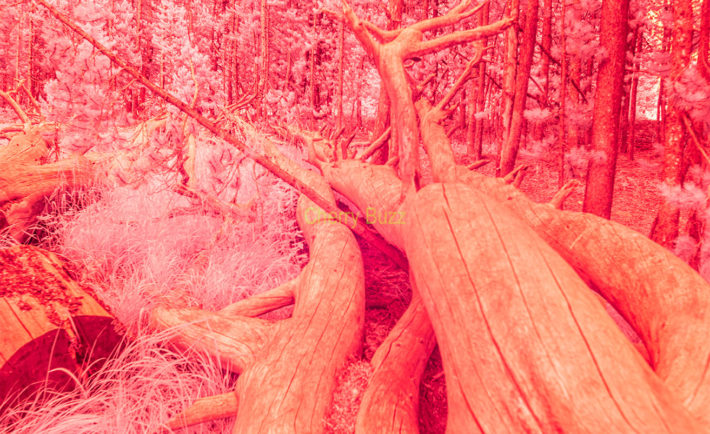
The Invisible Light: Infrared & Ultraviolet Photography
To understand these techniques & use them successfully, we need first to understand the light spectrum. The colors the naked human eye normally sees, which range from violet to deep red, form a small part of it; they occupy light wavelengths ranging from around 380 nanometers (nm) to 750 nm. Wavelengths which are shorter become Ultraviolet and those which are longer become Infrared. All the photos that we have taken so far in our capacity as amateur or professional photographers, from when the camera was first invented (1816) up to recent days, have utilized that small part of the light spectrum. From black and white images (1826) the move to color photography (1861) was hailed as a great improvement, which indeed it was. But nowadays, creativity has moved far beyond that and modern technology is opening ever wider doors into realms undreamed of before. When technology weds art, the result becomes utterly fantastic and even unearthly! This is what Infrared (IR) and Ultraviolet (UV) photography is all about. It allows photographers to capture what the naked eye cannot see and what ordinary cameras are not designed to capture. In fact, cameras are normally fitted with filters to screen off those wavelengths.

This brings us to what you need in order to get the results you seek to achieve with Infrared and/or Ultraviolet photography. Short of buying a new camera, one easy & inexpensive solution is to acquire a filter to place in front of the lens of the camera you already have. After experimenting with it and once you are convinced that this is the way forward for you, you can have your camera converted to the technique you desire. It will cost you but will still be less expensive than an outright new camera. The only snag is once converted there is no way back; your camera cannot revert to its old practices.

Infrared photography began in the early years of the 20th century and proved very useful during WWI and later in WWII as well. But it was the introduction of digital cameras in the late 1990s that weighed decisively in favor of these modern techniques. Infrared photos are easily recognizable by their eerie and otherworldly glowing whites and jet-black contrasts or by their strange colors. Because it reveals what the eye normally cannot see and in quite strong contrasts, infrared photography has proved itself extremely useful in forensic investigations. In the film industry, it is responsible for numerous surreal or otherworldly effects. When IR photography is used, almost everything looks extremely different from what it looks like within the visible light spectrum and, in short, this is what constitutes its magic. One good piece of advice, however, is to remember always that living entities, trees, foliage or a butterfly, reflect a greater amount of infrared light than inanimate objects such as concrete walls or mountains.

Ultraviolet photography uses light from the Ultraviolet (UV) spectrum only. “There are two ways to use UV radiation to take photographs – reflected ultraviolet and ultraviolet induced fluorescence photography.” The first is most useful in medicine, especially dermatology, in botany and in forensic investigation etc. The sun is the source here, a natural source which is readily available, except on cloudy or rainy days. But UV induced fluorescence photography must take place in a darkened room. In this case, it is not enough to use a filter, as in infrared photography. The camera must be modified, and UV capable lenses must be fitted.

Ultraviolet photography gives fascinating results especially with flowers and insects. It reveals in flowers, for instance, patterns hidden from the human eye but seen only by insects who are being attracted as pollinators. This is like opening new doors of perception, allowing us, humans, to experience the world around us in ways never explored before. It allows us literally to have a bird’s or an insect’s eye view of the world around us.

Using this technique, some photographers have certainly produced photos that are stunningly beautiful thereby transforming ordinary blooms into things out of this world. One such photographer is Craig Burrows who lives and practices in Southern California. According to Craig, flowers, plants and leaves are all naturally fluorescing when exposed to sunlight, but the naked eye cannot see that because of the intensity of the reflected visible light. In other words, ultraviolet photography is giving us a truer view of the flowers than our eyes can give us. Truth, trick or art, whichever way you look upon it, the results are breathtakingly beautiful even without any photo processing as switching color channels.

For more information, please see the following links:
https://www.amateurphotographer.co.uk/technique/camera_skills
article by Alex Morrison at https://digital-photography-school.com/how-to-do-surreal-digital
Using Ultraviolet Light to Make Nature Fluorescence in Photos by Don Komarechka in https://petapixel.com/2017/09/21/using-ultraviolet-light
article by Dunja Djudjic at https://www.diyphotography.net/photographer-takes-photos-flowers
wikipedia
-
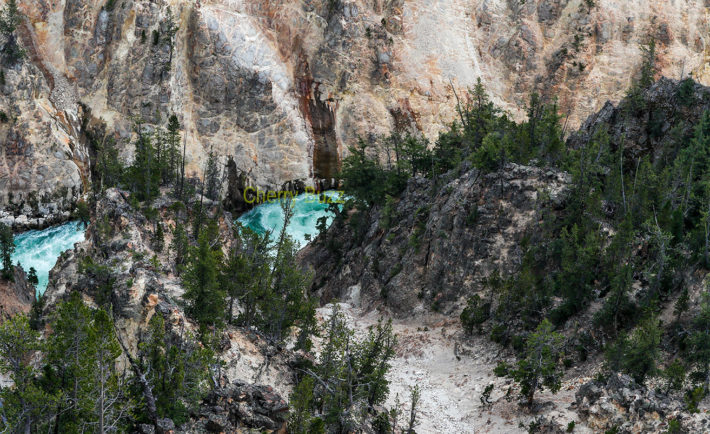
Yellowstone National Park in Summer
Yellowstone National Park was the first of its kind to be established in the USA (1872). Many regard it as the first in the world but there is evidence that the Bogd Khan Mountain National Park in Mongolia, which may date as early as 1778, preceded it. Yellowstone was designated a UNESCO biosphere reserve in 1976 and a World Heritage site in 1978. [Kenneth Pletcher, Yellowstone National Park, Encyclopaedia Brittanica: https://www.brittanica.com/place/Yellowstone-National-Park] It occupies some 2.2 million acres in northwestern Wyoming and southwestern Montana. Yellowstone sits on a high plateau averaging 8,000 feet in elevation. The Park forms the core of the Greater Yellowstone Ecosystem (GYE) which comprises approximately 18 million acres of land in 3 states: Wyoming, Montana, and Idaho. “This area is the last intact contiguous temperate ecosystem in the world”. It still contains nearly all of the living organisms which teamed in pre-Columbian times, though perhaps not in the same numbers.

This unique ecosystem, with its biodiversity and geothermal features, is closely related to the geologic history of the Park. Glaciation, tectonic activity and volcanic eruptions have shaped the landscape and life within the Park for millions of years. After all it sits on top of the caldera of a supervolcano! In the last 2 million years, it is thought that 3 gigantic eruptions occurred which account for much of its geographic, geologic and demographic nature to-day. It is unique in the abundance of geothermal features: a whopping 10,000 in total. It has 500 active geysers which is more than 55% of the geysers in the whole world! This fact becomes all the more staggering when one finds out that Russia has only 200, New Zealand about 40, Chile 38 and Iceland 25. [Thermal Biology Institute, TBI, An Overview of Yellowstone Geologic History] By far the most spectacular of the Park’s geysers is the Steamboat, the world’s tallest, which is capable of forcing boiling water more than 300 feet into the air. Another equally famous geyser is Old Faithful, the most frequent, erupting approximately every 78 minutes.

Hundreds of species of mammals, birds, fish, reptiles and even microbes abound and are studied and documented. The vast forests and grasslands also include unique species of plants. Yellowstone is indeed the largest and most famous megafauna location in the US. Native Americans are known to have lived, hunted and fished in the region as far back as at least 11,000 years ago. They used the obsidian, found in the park in significant quantities, to make cutting tools and weapons. It is amusing, however, that after the official establishment of Yellowstone as a National Park and the appointment of its first superintendent, Nathaniel Langford, that that gentleman had to work for 5 years (1872-1877) without a salary! He was also never given any funding nor the support staff needed to carry out the job! It was after Langford quitted his post in 1877 that Congress finally agreed a salary for the post while also providing a minimal funding!.

Nevertheless even in those early days, Yellowstone National Park had numerous lovers who extolled its beauty and charm. Thus in 1898, the naturalist, John Muir, described the Park as follows: “However orderly your excursions or aimless, again and again amid the calmest, stillest scenery you will be brought to a standstill hushed and awe-stricken before phenomena wholly new to you. Boiling springs and huge deep pools of purest green and azure water, thousands of them, are splashing and heaving in these high, cool mountains as if a fierce furnace fire were burning beneath each one of them; and a hundred geysers, white torrents of boiling water and steam, like inverted waterfalls, are ever and anon rushing out of the hot, black underworld. Such praise helped increase the visitors over the years to the extent that, from 1995 to 2003 Yellowstone National Park was placed on the List of World Heritage in Danger due to the effects of tourism, infection of wildlife, and issues with invasive species.

Another characteristic of this marvelous region is its seismic activity. In fact the Park’s features are the result of the supervolcano underneath it coupled with tectonic movement. Earthquakes are so frequent that many might have, in the past, gone unnoticed. The University of Utah’s seismograph stations detected more than 3,200 earthquakes in the Park in 2010 alone!.

The frequent earthquakes in the Park are sometimes referred to as earthquake swarms because they happen so close upon each other. Thus, for example, in January of that same year, 2010, over 250 earthquakes occurred in a two-day period! The Yellowstone Caldera is the largest volcanic system in North America. It gained the name ‘supervolcano’ because the caldera was formed by 3 exceptionally large and cataclysmic eruptions, the last of which took place more than 600,000 years ago. At present, the caldera is thought to be a single connected chamber about 37 miles (60 km) long, 18 miles (29 km) wide, and 3 to 7 miles (5 to 12 km) deep!.

Yellowstone National Park has one of the world’s largest petrified forests. In such forests, trees which were long ago buried by ash and soil have changed from wood to mineral materials. And as if all this is not enough to tempt visitors, the Park boasts 290 waterfalls, the lowest being at 15 feet, the highest, which is the Lower Falls of the Yellowstone River, at 308 feet (94 m). There are 3 deep canyons in the park, cut through the volcanic tuff of the plateau by rivers. Because the seismic activity is none stop and changes do occur all the time, a partnership was started in May 2001 joining the U. S. Geological Survey, the Yellowstone National Park Service and the University of Utah. The goal of the partnership was long-term monitoring of this geologically ever active region as well as the assessment of hazards and the spreading of accurate information thereof. This is also the time the Yellowstone Volcano Observatory was set up to keep an eye on the Park’s dynamic activity. While most do not think an eruption is likely in the near future, it is reassuring to know that everything is being monitored.

Another common hazard in parks and moorlands is wildfire & Yellowstone National Park has had a fair share. But it is pertinent to note that trees & plants indigenous to Yellowstone have adapted to that in numerous way. Thus, for instance Douglas-fir have a thick bark which protects the inner section of the tree from most fires. For some species of trees, notably lodgepole pines, wildfires help clear out dead wood while dispersing the seeds. The National Park Service estimates that in natural conditions, grasslands in Yellowstone burned on average every 20 to 25 years while forests in the park would experience fire about every 300 years. Because of the variation in altitude, different parts of Yellowstone National Park have different temperatures with the lower altitudes being warmer all year-round than the higher. The summer months see millions of visitors with July being the busiest month of the year but guided snowmobile and snow coach tours take place in winter, too. There are 9 visitor centers and museums & a dozen campgrounds are available with more than 2,000 campsites. Hunting is not allowed in Yellowstone National Park although it is permitted in the surrounding national forests during open season. Fishing is allowed but a Yellowstone Park fishing license is required & all indigenous fish species are catch and release only.
There are 5 entrances to Yellowstone National Park, 2 in Montana (Gardiner and Cooke City), 2 in Wyoming (Cody and Jackson Hole) and 1 in Idaho (Island Park). Each of the towns closest to entrances has its attractions and stunning beauty; your choice of entrance depends partly on where you are driving from and partly on the main magnet drawing you to the Park. If, for instance, you are drawn there by a desire to see Mammoth Hot Springs then Gardiner, in Montana, is your best entrance. If it is wildlife you are after then Cooke City is the town for you. If you are after Yellowstone Lake with its numerous geothermal features then Cody, in Wyoming, is the city for you. It is the city founded by Buffalo Bill Cody himself; it celebrates its old western heritage with daily summer rodeos and boasts a fantastic Buffalo Bill Center. But if your intention is to see two national parks in one visit, Grand Teton National Park and Yellowstone National Park, then Jackson , Wyoming, is the town for you. Jackson itself is an amazing mountain town which blends beautifully the Old West with modern glamour. It is a very popular destination both in winter, for all types of winter sports, and summer and its friendly people cater for all kinds of visitors with a full range of hotels, guest ranched, fantastic dining and lots of outdoor recreation. The Town Square has the first of Jackson’s famous arches made from the naturally shed elk antlers. The whole family can have lots of fun in Jackson which, besides the usual gift shops and ice-cream parlours, is actually a hub for music, theatre, and art activities. Its National Museum of Wildlife Art has a unique collection of paintings and sculptures. Town Square also has another unique feature: the iconic Million Dollar Cowboy Bar the interior of which is filled with cowboy memorabilia and historic photos etc.

Yellowstone was established as the world’s first national park in 1872 but continued to attract visitors every month of the year. We visited Yellowstone National Park in summer which is the busiest season of the year. In summer, all the roads are open and the whole large park can be navigated easily depending on the NPS Yellowstone National Park app (from the Apple App Store) and local maps/GPS.
For more information, please see the following links:
https://nps.gov/yell/learn/nature/geology.htm
https://www.frommers.com/destinations/yellowstone-national-park/landscape
https://www.yellowstonehikingguides.com
Patry, Marc et.al. (March 11-13, 2003) “The State of Conservation of World Heritage Forests”. Proceedings of the 2nd World Heritage Forest Meeting. Archived. from the original on January 26, 2012.
https://www.audleytravel.com/usa/places-to-go/yellowstone.
https://en.m.wilipedia.org/wiki/Yellowstone_National_Park.
Muir, John (April, 1898). “The Yellowstone National Park”. The Atlantic. Archived from the original on March 12, 2017.
https://traveltips.usatiday.com/towns-bearest-yellowstone-park-54182.html
https://www.yellowstonepark.com/road-trips/hackson-hole-wy
https://www.yellowstonepark.com/park/yellowstone-park-entrances
-

Andrew Jackson’s Hermitage
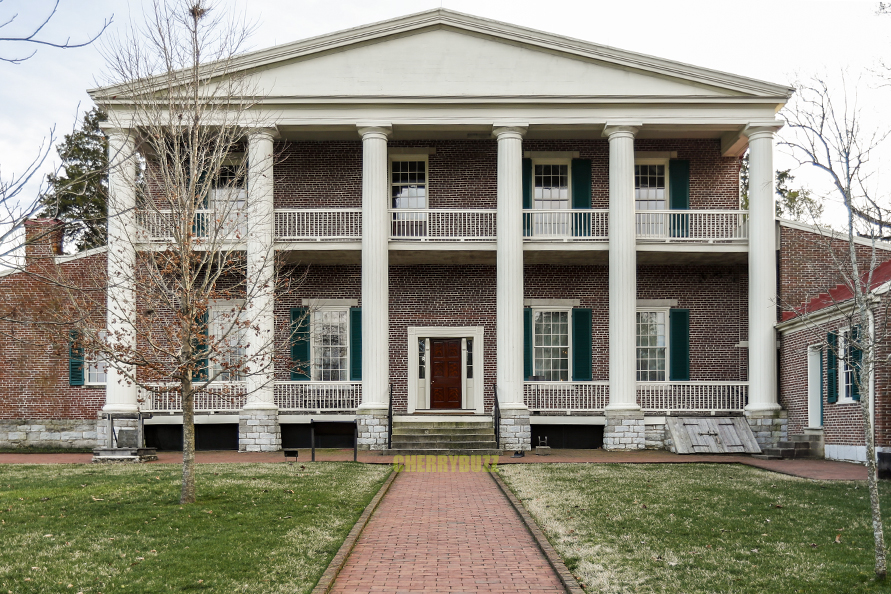
In this post, I wanted to share the experience of a visit to Andrew Jackson’ Hermitage in Nashville, Tennessee. The Hermitage, was the residence of US seventh president, Andrew Jackson the seventh president of the United States, from 1829 to 1837. Jackson redefined the meaning of being a true representative of “the people” but not without a controversial and often quite surprising presidential era. He helped to inspire a new era of belief and hope in the American dream.

Andrew Jackson was the first chief executive elected from west of the Allegheny Mountains, the first from other than Virginia or Massachusetts, and the first non-aristocrat. Over and above his charisma, which gained him the nick-name “Old Hickory”, he is said to have “not only expanded the powers of the office of president but also virtually redefined them.”

Michael Beschloss, an American historian quoted a famous prayer of John Adams, the first “president to live” in the White House, that heaven “bestow the best of Blessings on this House and all that shall hereafter inhabit it” and that “none bur honest and wise men ever rule under its roof.” The author then argues that the five presidents who followed Adams seem to suggest that his prayer has been heard. “Thomas Jefferson, who demanded ‘a government rigorously frugal and simple’ and had the foresight to double the size of the new nation with the Louisiana Purchase; James Madison, who took the country through the War of 1812 and helped establish the United States as a world power; James Monroe, who fashioned an enduring foreign policy doctrine; John Quincy Adams, who set the need for a national system of roads and canals, thoughtful regulation of national resources, and government aid to education; Andrew Jackson, who expanded the powers of the office, waged war against the notion of a national bank, expunged the national debt, and became a people’s hero.”

Andrew Jackson preferred the title General after he left the white house in 1837. During the War of 1812, General Andrew Jackson led his troops through enemy territory to victory. General Jackson defended New Orleans against a full-scale attack by the British and forced them to withdraw. That war resulted in the procurement of millions of acres in the present-day southern United States, including Florida. It’s worthy mentioning that Jackson’s toughness and solid determination reminded his troops of a firmly rooted Hickory tree, and earned him the nickname “Old Hickory.”

The US state of Tennessee is the 36th largest and 16th most populous of the 50 United States of America. It boasts innumerable attractions and offers visitors unforgettable memories! They can soak in the beauty of nature while walking in the Great Smoky National Park, spend hours fishing in its rivers or wander among its abundant landmarks in American history.
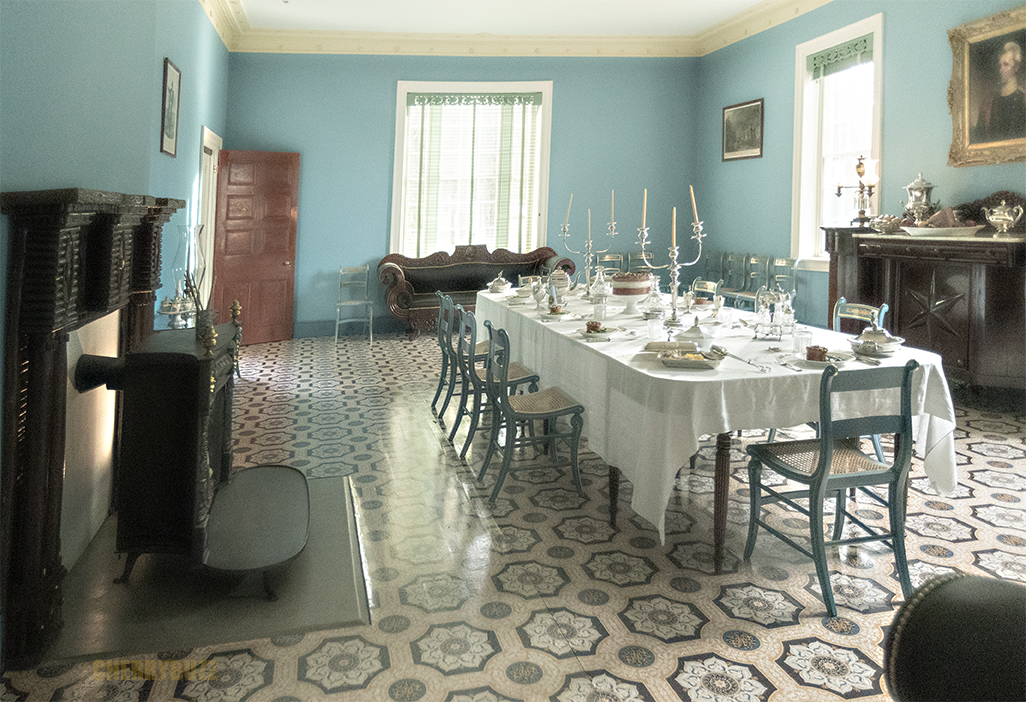
Tennessee is where The Hermitage, residence of US seventh president, Andrew Jackson, is located. The ownership and control of the mansion and 25 acres of land was granted to the “Ladies’ Hermitage Association”. The Association opened it to the public. To-day’s visitors will find it restored to how it looked when Andrew Jackson returned to it after serving his second term. The tour in the Hermitage brings the visitor closer to Andrew Jackson the general, the president and the “common man” who had no formal military training prior the war of 1812.
During the residence tour, guests at the Hermitage are encouraged to ask questions and take full advantage of The Hermitage’s friendly and well trained staff. I recommend that tour to all visitors to Nashville, TN.
Nashville is also home to many famous African American writers such as Amiri Baraka, Toni Morrison and Alex Haley, music legends such as Bob Stagner, Charlie Bowman and Chuck Butler as well as ingenuous photographers such as Matthew Simmons, John Gentry and Liza Hippler. Besides being the capital of the state, it is also Country Music Capital, USA if not of the world. Other music genres, seven in all, call Tennessee home! It has legendary country music venues such as the Grand Ole Opry House which offers weekly country music stage concerts. It was founded on November 28, 1925 as the backdrop of a one-hour radio “barn dance” program and from then to the present, it has been the longest running radio broadcast in US history. Among the innumerable museums that Tennessee boasts are: Stax Museum of American Soul Music (Memphis),Tina Turner Museum and Flagg Grove School (Brownsville) and Withers Collection Museum and Gallery (Memphis). Nashville has what seems to me to be the largest ever auditorium, Ryman Auditorium. As a live performance venue, its seating capacity is 2,362! From 1943 to 1974, it was the home of the Grand Ole opry stage and radio show.
For more information, please see the following links:
https://thehermitage.com/visit/visitor-faqs/
https://www.nps.gov/nr/travel/presidents/jackson_hermitage.html
-
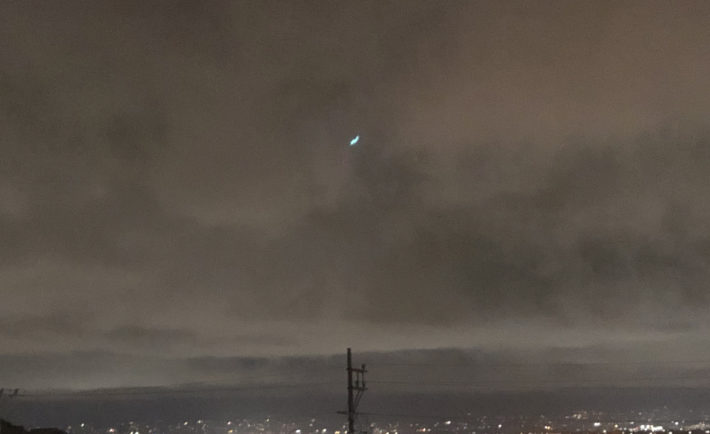
2019 Lunar Eclipse Super Blood Wolf Moon
In August 2017, we treated out readers to an article and wonder-striking photos of a total Solar Eclipse. That was an unmissable spectacle for millions of people of all ages.
The January 20th, 2019 Super Blood Wolf Moon has promised and delivered a no less amazing spectacle. But before we continue, it is well to explain briefly what the longish name means.
A Super Moon is a moon at its closest distance from Earth, which in astronomical jargon is to say when the moon is at the Perigee. Being over 30,000 miles closer than it is at its farthest point away, the moon appears up to 14% bigger and 30% brighter than at other times of the year. This is much enhanced if when the moon is at Perigee it happens also to be a full moon. Unfortunately for many of us, this might not always be seen with the naked eye due to adverse weather conditions and/or light pollution in most major cities. But weather and other factors permitting, it is a dazzling spectacle!.
Super Moons, in themselves, are quite common though. There have been four (4) in 2018 but only one of them coincided with a full moon. Apart from other celestial phenomena, such as the spectacular meteor shower earlier this month, our moon this month (on January 20th in the US) coincided with a full moon. Furthermore, what made this January Super Moon a more interesting and rare occurrence is indicated in the remaining details of the name. The ‘Blood’ part marks the fact that the Super Moon seems to glow red as it emerges from a total lunar eclipse. Lunar eclipses are not uncommon; three (3) lunar eclipses were seen in various parts of the world in 2018. NASA, however, reckons that after this January Lunar Eclipse there will be no other total lunar eclipses till May 2021.
Moreover, what makes this eclipse rare is the fact that it coincided with a Super Moon. As the three celestial bodies, Sun, Earth and Moon, became perfectly aligned, the light refracted from the Earth’s air threw a reddish hue onto the face of the Moon. This is because the Earth’s atmosphere scattered all the short-wavelength light (in colours like green or blue) and left only longer-wavelength light which comprise the redder end of the spectrum. Hence the name: Blood Moon. It is good to remember that, unlike Solar Eclipses, which you need special protective goggles for, Lunar Eclipses are safe to look at with the naked eye.
The ‘Wolf’ part of the name goes back to Native American traditions from days preceding the use of solar calendars. Lunar calendars used different names for the months and were closely linked to people’s observations of their natural surroundings. Native Americans called the Full Moon in mid-winter Wolf Moon because of the all too frequent howling of hungry wolves out in search of food.
To witness all three phenomena in one go is what made this January 2019 Super Blood Wolf Moon a rare and indeed unmissable experience. Millions upon millions of people in North and South America, parts of Western Europe and Africa were able to catch that rare sight overnight on Jan 20 into Jan 21. It is pertinent here to note that the longest possible lunar eclipse is 1 hour and 47 minutes and that the longest total lunar eclipse of the last century, which occurred on July 16, 2000, lasted 1 hour and 46.4 minutes. This time (20/21 Jan. 2019) it did not last as long (only 1 hour and 2 minutes) but was no less spectacular!.
Unfortunately the viewing conditions based on weather were poor on the western half of the US ON Sunday 20, 2019. Few hours later, the sky became clear.

For more information, please visit the following links:
- https://www.nationalgeographic.com/science/2019/..
- https://inews.co.uk/news/ science/super-blood-wolf-moon-lunar-eclipse ..
- https://www.foxnews.com/science/rare-super-blood-wolf-moon-eclipse ..
- https://www.countryliving.com/wildlife/..
- https://news.sky.com/story/lunar-eclipse-rare- …
- https://www.theweathernetwork.com/news/article/winter-sk..

-
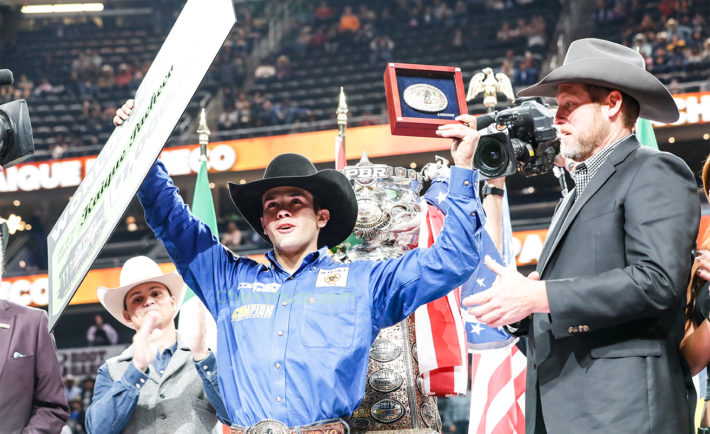
2018 PBR World Finals November 11th/ Day 5
On November 11th, the 2018 PBR World Finals was indeed a most exhilarating sports event offering maximum excitement and a rare chance to meet and mix with some of the best champions in the field. Kaique Pacheco (24 years, Itatiba Brazil) won the 2018 PBR World Champion title with total 2018 earnings of $1,535. Marco Eguchi (29 years, Poia Brazil) is the 2018 World Finals event winner with total 2018 earnings of $372,000). Keyshawn Whitehorse (21 years, McCracken Springs, UT, USA) won 2018 Rookie of the Year award with total 2018 earnings of $103,523.

Kaique Pacheco, the 2018 PBR World Champion with PBR CEO Sean Gleason 
Marco Eguchi, the 2018 World Finals event winner and his family with PBR CEO Sean Gleason 
Keyshawn Whitehorse, the 2018 Rookie of the Year and his family with PBR CEO Sean Gleason


 Mason Taylor came in first place in round 3 and the competition contiues.